Description
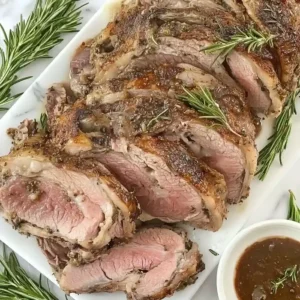
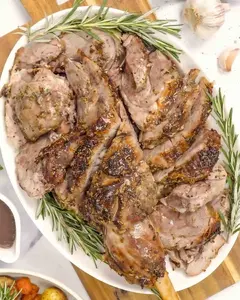
A flavorful garlic herb roasted leg of lamb, perfect for special occasions or family dinners.
Ingredients
Scale
- 4 to 5 pounds (1.8 to 2.3 kg) bone-in leg of lamb, trimmed of excess fat (retain some fat for moisture)
- 6 cloves garlic, minced (fresh)
- 1 tablespoon dried rosemary
- 2 tablespoons Dijon grainy mustard
- 2 tablespoons olive oil (good quality extra virgin)
- Salt, to taste
- Black pepper, to taste
- ½ cup (120 ml) dry red wine (optional for gravy)
- 1 cup (240 ml) chicken broth (additional 1 cup for gravy optional)
- 1 tablespoon all-purpose flour (for gravy thickening)
Instructions
- Step 1: Make the Garlic Herb Rub: In a small bowl, whisk together 2 tablespoons Dijon mustard, 6 cloves minced garlic, 1 tablespoon dried rosemary, 2 tablespoons olive oil, salt, and black pepper. Whisk until the mixture forms a uniform paste to help the flavors adhere to the lamb.

- Step 2: Trim and Prepare Lamb: Trim excess fat from the leg of lamb, leaving enough to maintain moisture and flavor. Use a sharp knife to make shallow incisions in the meat to allow better penetration of the rub.
- Step 3: Massage and Rest: Rub the garlic herb mixture generously all over the lamb, making sure the rub gets into the incisions. Let the lamb rest at room temperature for about 30 minutes to allow flavors to absorb evenly and to promote even cooking.
- Step 4: Preheat and Roast: Preheat your oven to 425°F (218°C). Place the lamb on a roasting rack or in a roasting pan. Roast at 425°F (218°C) for 20 to 25 minutes to form a crust. Then reduce the oven temperature to 350°F (177°C) and continue roasting for approximately 1 hour 35 minutes to 1 hour 40 minutes, or until the internal temperature reaches about 135°F (57°C) for medium-rare doneness.
- Step 5: Check for Doneness: Use a meat thermometer inserted into the thickest part of the lamb (avoid bone) to check temperature. When it reaches 135°F (57°C), the lamb is medium-rare and juicy.
- Step 6: Rest Before Carving: Remove the lamb from the oven and allow it to rest on a cutting board for at least 15 to 20 minutes. Resting locks in the juices and makes carving easier without drying out the meat.
- Step 7: Optional Pan Gravy: To make a gravy, pour off excess fat from the roasting pan, add ½ cup (120 ml) dry red wine and 1 cup (240 ml) chicken broth to the pan drippings and bring to a boil. For thicker gravy, whisk in 1 tablespoon all-purpose flour 5 minutes before serving, stirring until smooth and thickened. Adjust flavor and thickness as desired.
Notes
- Room Temperature: Store the roasted lamb in an airtight container at room temperature away from direct sunlight or heat sources for up to 2 days.
- Refrigeration: Allow lamb to cool completely, then store in an airtight container in the refrigerator for up to 5 days.
- Freezing: Wrap tightly with plastic wrap and place in a freezer-safe container. Freeze for up to 3 months. Thaw overnight in the refrigerator before reheating.
- If the seasoning does not stick well to the lamb, pat the surface dry with paper towels before applying the garlic herb rub.
- If the lamb is tough or overcooked, ensure the internal temperature reaches about 135°F (57°C) for medium-rare; use a meat thermometer for accuracy.
- To keep meat moist during roasting, baste the lamb with 1 to 2 tablespoons chicken broth every 30 minutes.
- Rotate the lamb halfway through roasting to promote even cooking and consistent doneness throughout.
- For thicker gravy, whisk in 1 tablespoon flour 5 minutes before serving as the broth mixture boils.
Nutrition
- Serving Size: 1 serving
- Calories: Not provided
- Sugar: Not provided
- Sodium: Not provided
- Fat: Not provided
- Saturated Fat: Not provided
- Unsaturated Fat: Not provided
- Trans Fat: Not provided
- Carbohydrates: Not provided
- Fiber: Not provided
- Protein: Not provided
- Cholesterol: Not provided